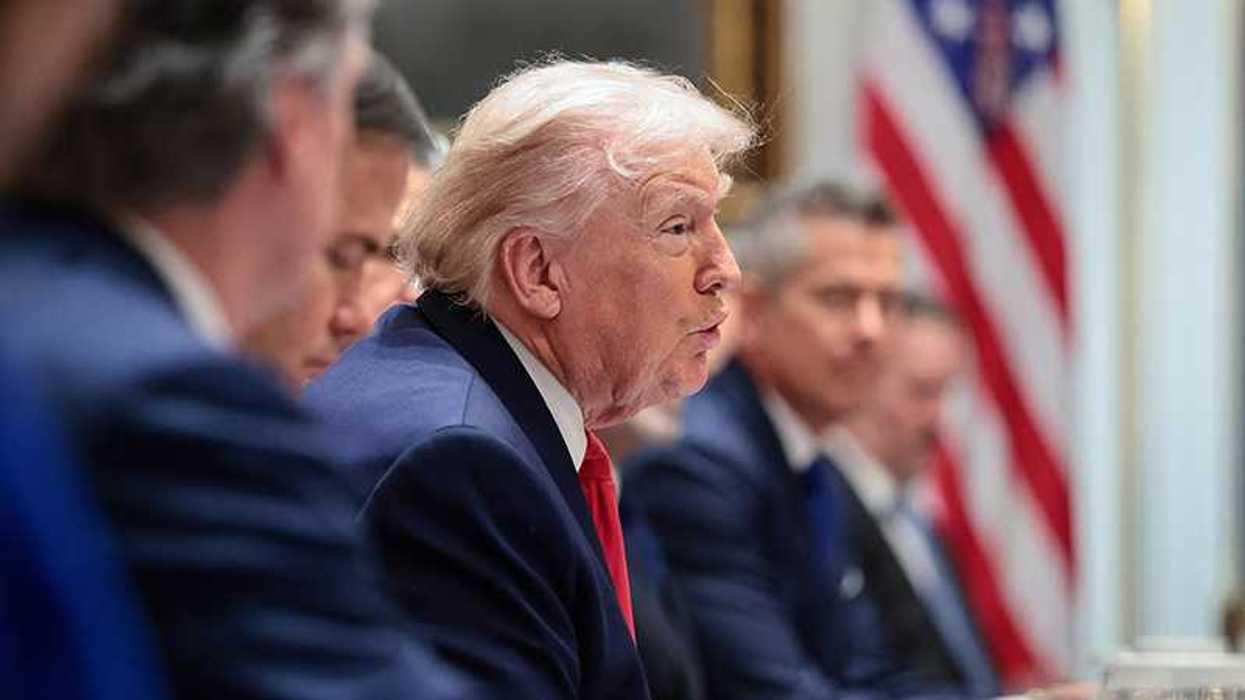
President Donald Trump is using Pentagon funds that Congress never appropriated, crafting its own memo to skirt the law.
Normally, the Pentagon buys things from companies: weapons, equipment, supplies and services. Semafor reported on Monday that now, the Department of Defense is investing taxpayer money in companies and receiving a piece of ownership in return. It's similar to how a private investor might buy stock in a business.
What's more, the White House is helping them figure out the legal barriers.
"The White House budget office responded with a previously unreported legal opinion, reviewed by Semafor, that provides a crucial look at how the Trump administration justified one of its most controversial deployments of taxpayer money in the private sector," said the report.
For example, the Pentagon made a deal involving rare-earth-minerals company MP Materials. It would ensure that the military had a $400 million equity ownership investment in the company. They also gave the company a $150 million loan along with other forms of support.
Congress appropriates funds. Their one job, as outlined in the Constitution, is to hold the purse strings, and Congress is fairly specific about what the money will fund. The law is meant to block presidents from spending taxpayer dollars on whatever they want, such as a ballroom or a large triumphal arch.
The White House thinks it found wiggle room around that. Prior to the minerals deal, the Pentagon asked the White House for help, and the budget office issued its memo saying that the Pentagon is allowed to spend the funds because it's addressing a "national security threat." It's the same demand Trump is making about the ballroom and now the triumphal arch.
The memo, penned by OMB general counsel Mark Paoletta, uses the Defense Production Act, a 2017 law, and the president’s constitutional powers to justify it's control.
Famously, Trump told an audience in July 2019, "Then I have an Article II, where I have the right to do whatever I want as president."
According to the Trump administration, the United States relies too heavily on China for critical minerals used in chips and other technology. So the administration is seeking to quickly establish its own U.S. supply chains propped up by the government.
A spokesperson for Senate Armed Services Committee chairman Sen. Roger Wicker (R-Miss.) told Semafor that he wants Congress to pass a law approving spending from the Pentagon’s Office of Strategic Capital however it sees fit.
Wicker “believes that an appropriately scoped equity investment authority is important for continued positive work in restoring a free market for critical minerals,” the spokesperson said. “But he also believes the department must regularize the process surrounding equity-based deals and increase its transparency with the Congress to render this approach sustainable over the long term.”
A former Pentagon official cited the Antideficiency Act as “one of the hurdles we thought was going to be insurmountable,” specifically regarding the MP Materials deal.
Another official who specifically worked for the Pentagon's Office of Strategic Capital warned that “laws can be elastic, but elasticity snaps at some point." They were "surprised that the current team has discovered the authority to do this under the Defense Production Act."
“I think this pushes the boundaries,” the official continued.
After World War II, the U.S. shifted away from overseeing the production of its own military equipment and began outsourcing production to military contractors. In his 1961 parting address, President Dwight D. Eisenhower warned that these companies were becoming too powerful and costing too much.